Chapter 10 of 11
Income from options: the wheel
A conservative way some dividend investors earn extra income: getting paid a premium for promising to buy or sell shares at a set price.
Options have a reputation for risky speculation, but income investors use a narrow, conservative corner of them: selling options on shares they already own or would happily buy. When you sell an option you are paid a premium up front — cash that is yours to keep — in exchange for a promise about a price. Done this way it is an income stream alongside your dividends, not a bet on where the market goes.
A cash-secured put is a promise to buy 100 shares at a set "strike" price if the stock falls that far, with the cash set aside to do it. You are paid a premium for the promise. If the stock stays above the strike, nothing happens and you simply keep the premium. If it drops below, you buy shares you wanted anyway — at the strike, minus the premium you already collected, so effectively at a discount.
A covered call is the mirror image, on shares you already own. You promise to sell 100 shares at a strike above today's price and collect a premium for it. If the stock stays below the strike you keep both your shares and the premium. If it rises above, your shares are sold ("called away") at that price — you still keep the premium, you just cap how much of the rally you capture.
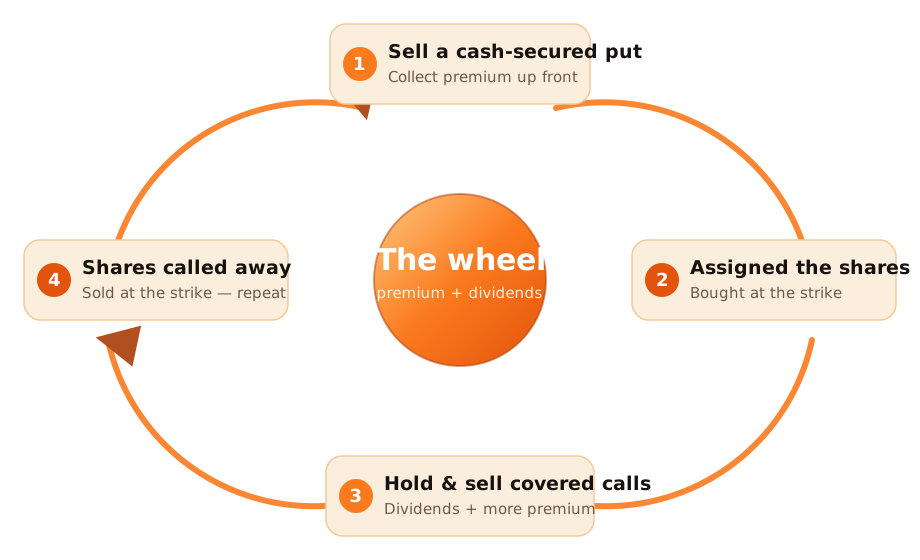
Chained together these become "the wheel": sell cash-secured puts until you are assigned shares, collect dividends while you hold them, then sell covered calls until the shares are called away — and start over. Every step earns premium or dividends. Quantic tracks the whole loop: log each put and call, see the premium booked as income, and when you are assigned the shares flow straight into your holdings and cost basis.
Quantic also reads each open position for you. It shows the break-even price (where the trade nets zero once the premium is spread over the shares), the annualized yield (the premium as a yearly return on the collateral, so a 30-day put and a 90-day call compare fairly), and the moneyness — how the current price sits versus your strike. When an option goes in-the-money close to expiry it flags the assignment risk, so you can roll it or let it happen on purpose.
Picking which option to sell is where most people go wrong. The obvious move — sorting by the biggest premium — reliably lands you on the worst companies, because premium is the price of risk: the market pays most to insure what it most expects to fall. The order that matters is the other way round. Decide first which companies you would be content to own for years, and only then ask which of them is paying best to wait.
Two numbers tell you most of what you need. For a put, the effective cost basis — the strike minus the premium you were paid — is what a share would really cost you if it were assigned, and the yield on cost that basis would give you is the dividend income you'd be buying. For a call, what matters is whether the strike clears what your shares cost you, so that being called away books a gain rather than a loss.
Treat an annualized figure with suspicion on short contracts. A seven-day option paying 0.5% annualizes to 26% — a rate nobody collects fifty-two times in a row. Read the return over the contract's own life first, and the yearly figure only as a way of comparing two contracts of different lengths.
One risk is easy to miss and specific to dividend investors: if a dividend goes ex while your covered call is open, the buyer has a reason to exercise early and collect it instead of you. Quantic knows your dividend dates, so it flags when one falls inside a contract you are considering — a warning no general options tool can give you.
The other date to look at is the earnings date. Results day is when a share price is most likely to move sharply and without warning, and a contract written across one carries that move: a disappointing quarter can drop the stock through the strike of a put you sold, and a good one can carry it past the strike of a call. Neither is a disaster — you wanted the shares, or you were happy to sell at that price — but it should be a decision rather than a surprise. Quantic shows the next reporting date on each candidate, and marks it when it falls inside the contract you are looking at.
Read that date carefully when it carries a tilde. Companies confirm their reporting day only a few weeks ahead; until then the date is an estimate carried forward from the previous quarter, and it can move by a week. An estimate is still worth knowing — it tells you roughly where the risk sits — but do not pick an expiry that depends on it being exact.
Premium is not free money. A cash-secured put can leave you buying a stock that kept falling; a covered call can cap your gains in a rally. Only sell puts on shares you would genuinely want to own, and calls at prices you would be happy to sell at.
Key terms
- Cash-secured put
- Selling a put while setting aside the cash to buy the shares if you're assigned. You collect a premium up front; if the stock stays above the strike you keep it as income, and if it drops you buy shares you wanted anyway at the strike — effectively a discount, minus the premium.
- Covered call
- Selling a call against shares you already own. You collect a premium as income; if the stock rises above the strike your shares are sold ("called away") at that price. A way to earn extra yield on holdings you'd be happy to trim.
- The wheel
- An income loop: sell cash-secured puts until you're assigned shares, collect dividends while you hold them, then sell covered calls until the shares are called away — and repeat. Every step earns premium or dividends.
- Break-even
- The price at which a sold option nets zero versus the strike, once the kept premium is spread over the shares. A cash-secured put breaks even that much below the strike (your effective purchase price if assigned); a covered call that much above it.
- Annualized yield
- The premium as a return on the collateral, scaled to a yearly rate over the days the option is held — so a 30-day put and a 90-day call compare on the same footing. A 2% premium over 30 days is roughly a 24%/yr run-rate. Treat it as a comparison aid, not an expectation: a 7-day option paying 0.5% annualizes to 26%, a rate nobody collects 52 times running.
- Downside buffer
- How far a share can fall before a put you sold is assigned — the gap between today's price and the strike, as a percentage. A wider buffer means less chance of buying the shares, and a smaller premium for waiting. Measured to your break-even instead of the strike, it's the fall you'd absorb before actually losing money.
- Moneyness
- Where the current price sits versus the strike. For an option you sold, in-the-money (ITM) means it's heading toward assignment; out-of-the-money (OTM) means it's on track to expire worthless so you keep the premium. Near expiry, an in-the-money option is at real risk of assignment.
- Earnings date
- The day a company publishes its results. Prices often move sharply on it, so it matters when you're choosing an option expiry or deciding whether to buy before or after. Until a company confirms the day, providers estimate it from the last quarter and it can shift.
Quantic · Free
Ready to put it into practice?
Explore a sample portfolio — no signup — or create your free account and start tracking your own dividends.
Need more? Pro adds portfolios, options income tracking & more AI. See Pro →